
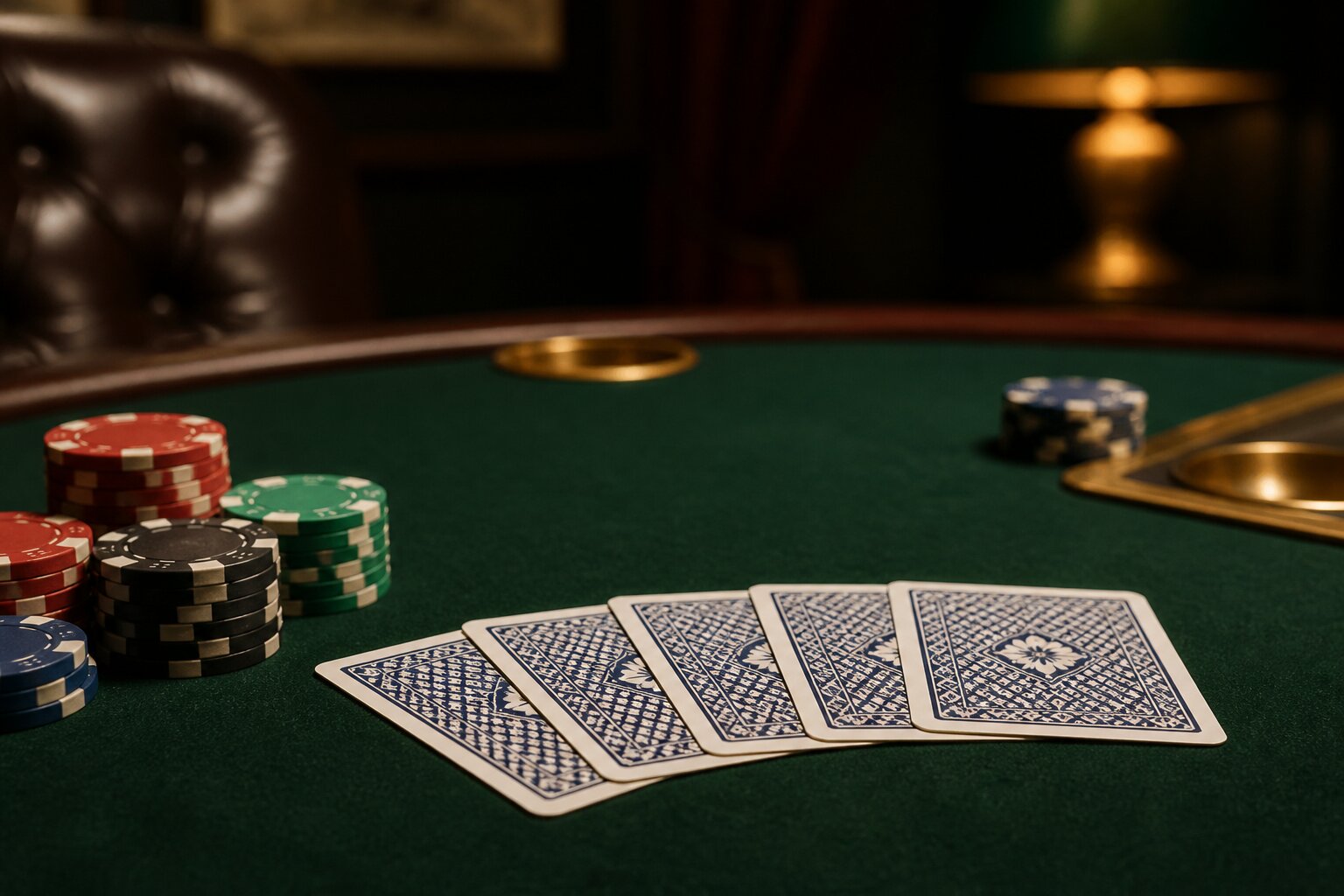
Ever watched an old film and seen players around a green felt table, nervously swapping cards and trying to stay poker-faced? Chances are, they were playing 5 Card Draw. This classic version of poker has been a staple in British pubs, family nights and home games for generations.
Unlike more modern takes like Texas Hold'em, 5 Card Draw keeps things simple: what you see is largely what you get, making it perfect for new players and seasoned card players alike. With just a single betting round before and after the draw, it is quick to learn and full of tense moments when decisions matter.
But the fundamentals only tell part of the story; the next sections unpack the rules, terms and flow of a hand so you can see why the game endures.
Understanding 5 Card Draw Poker
5 Card Draw is one of the most accessible poker games, often chosen for casual gatherings because each player receives five private cards, known as hole cards, and aims to make the best possible five-card hand. The usual table size is between two and six players, which keeps the action compact and easy to follow.
Play begins with an initial forced contribution to the pot, either an ante or blinds, and the dealer then deals five face-down cards to every player. After a first betting round, players may exchange a number of cards to try to improve their hand; following that, a final betting round determines who reaches the showdown and wins the pot. Since there are no shared community cards, much of the game is about interpreting opponents’ actions and the cards they keep or discard.
Understanding this basic flow helps when considering the finer points of betting and hand strategy, which are covered next.
Basic Rules of 5 Card Draw
Games use a standard 52-card deck, and either an ante or blinds creates the initial pot. The dealer deals five cards to each player, usually starting with the player to their left and proceeding clockwise. After looking at their cards, players decide whether to stay in by calling, to raise the bet, or to fold.
Following the first round of betting, players can discard and receive replacement cards, normally up to three, though some home rules vary. Once drawing is complete, there is a second betting round before any remaining players reveal their hands. The highest-ranking five-card hand wins the pot, using the familiar poker hierarchy from high card up to straight flush. Examples of typical choices include keeping a pair and drawing three cards to chase trips, or standing pat on a strong made hand to protect its value.
With the essentials of dealing and betting understood, the next section explains how betting structures are commonly applied in this game.
How Does Betting Work in 5 Card Draw?
Betting in 5 Card Draw follows standard poker conventions and is commonly played with fixed-limit stakes in casual games. Fixed-limit sets the amount for bets and raises, for example a £1/£2 structure where bets before the draw are £1 and bets after the draw rise to £2. Other formats exist, such as pot-limit or no-limit, but fixed-limit keeps decisions simpler and the pot sizes predictable.
Each hand begins with forced contributions, either an ante from every player or blinds posted by the two players to the dealer’s left. After the initial deal there is a betting round in which players can fold, call, raise or check when no bet is outstanding. Once draws are completed, a second betting round occurs using the same options, and the hand proceeds to showdown if more than one player remains.
Knowing the betting format influences how aggressively players draw and how they size their bets, and these choices relate directly to common poker terms described next.
Essential Terms in 5 Card Draw Poker
This short glossary explains the common words you will see at the table.
-
Ante
A small compulsory bet everyone places before the deal, for example 50p each. -
Blinds
Forced bets posted by the two players to the dealer’s left, typically called the small blind and big blind. -
Deal
Distributing five face-down cards to each player at the start of the hand. -
Draw
Discarding unwanted cards and receiving replacements from the deck, usually up to three cards. -
Bet
Placing money into the pot during a betting round. -
Call
Matching the current bet to stay in the hand. -
Raise
Increasing the size of the current bet, which others must match to continue. -
Fold
Exiting the hand and forfeiting any claim on the pot. -
Check
Passing the action without betting, only allowed when no bet has been made in that round. -
Showdown
The point after the final betting round when remaining players reveal their cards to determine the winner.
With those terms clear, the following section describes the dealing and drawing in a way that shows how a hand progresses from start to finish.
The Dealing and Drawing Process Explained
A hand unfolds in a recognisable sequence that gives every player a single chance to change their fate. Once antes or blinds are in place, the dealer shuffles and deals five face-down cards to each player, one card at a time, moving around the table. Players then examine their hands and assess their choices during the first betting round, deciding whether to commit more chips or bow out.
After betting, the drawing phase allows each player an opportunity to improve their hand by discarding unwanted cards and taking replacements from the deck. Players commonly discard up to three cards; someone holding two pair will often discard the odd card in the hope of drawing to a full house, while another player with a promising straight or flush draw might stand pat to protect a strong holding.
The dealer supplies replacements from the top of the deck after everyone has declared their discards, so the order and timing are important for fairness. With new cards in hand, the final betting round follows and then, if multiple players remain, a showdown reveals the best five-card hand and settles the pot. This straightforward progression is what gives the game its rhythm and tension, and it also highlights why observation and timing matter so much.
The next section contrasts 5 Card Draw with other popular poker forms to show how those differences change the way hands are played.
Comparing 5 Card Draw to Other Poker Variants
5 Card Draw is often called a pure form of poker because each player relies solely on their private hand, with no community cards to share. That simplicity contrasts directly with other variants, where visible cards and additional betting rounds create different strategic demands.
In Texas Hold'em, players receive two private cards and share five community cards, with betting occurring over four stages. The community cards mean players make hands from a mix of private and shared cards, so reading the board and calculating possible hands becomes a larger part of the game. In contrast, 5 Card Draw compels a focus on what opponents keep or discard and how they bet.
Omaha gives each player four private cards and requires exactly two of them to be used with three community cards to form a hand. Because players have more hole cards, potential hand combinations are larger and showdowns often involve high-ranked hands. These contrasts explain why table dynamics and betting patterns feel different across variants, and they help players choose the style that best suits their preference.
Having looked at how 5 Card Draw compares with other games, the final section examines what keeps players returning to this format.
What Makes 5 Card Draw Appealing?
The appeal of 5 Card Draw lies in a balance of simplicity and subtlety. The rules are easy to teach, so newcomers can join a game quickly, while the single drawing round and limited betting create moments where small decisions carry weight. Choosing whether to discard or stand pat, or when to raise to test an opponent, gives the game a quiet strategic depth that rewards careful observation.
There is also an emotional pull. For many players in the UK, this is the version of poker learned at home or around a pub table, played for modest stakes and for company as much as competition. The format encourages friendly rivalry and conversation without requiring a deep knowledge of complex betting mechanics.
Keep play at modest stakes and agree limits with your fellow players so the game stays social and enjoyable. With that in place, 5 Card Draw remains a compact, engaging way to spend an evening with friends or family.
Play Casino Games Online at Online Slots UK
At Online Slots UK, we welcome you to enjoy the choice and variety available on our site. Whether you prefer to explore new experiences or revisit familiar favourites, there is always something to enjoy.
Getting started could not be easier: simply create an account, make your first deposit and you are ready to play. We look forward to sharing the fun with you.
**The information provided in this blog is intended for educational purposes and should not be construed as betting advice or a guarantee of success. Always gamble responsibly.