
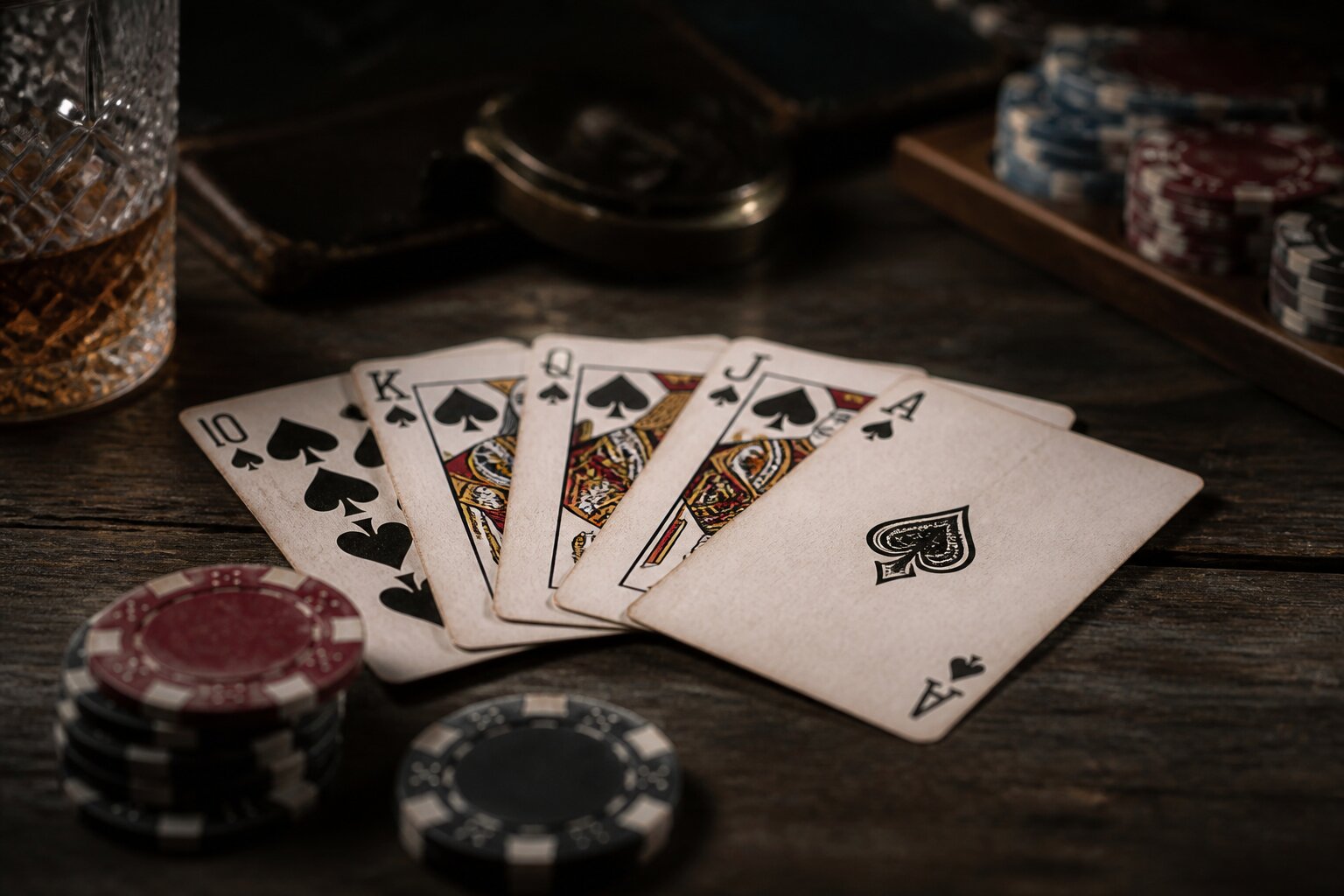
Picture yourself at a poker table, the cards are dealt, drinks are flowing, and there’s a buzz of conversation around the room. You glance at your hand: the ace of spades and the eight of clubs. For some, it’s just another pair of cards, but for others it carries a reputation that can make the air go quiet.
The “Dead Man’s Hand” has been whispered about in saloons, novels and films for generations. Is it simply Western folklore, or did a real event give these two pairs their ominous tag?
Whether you play poker regularly or only know a handful of hands, the Dead Man’s Hand is one of those pieces of poker lore that sticks in the mind. The next section explains exactly what people mean when they use the name.
What Is the Dead Man’s Hand in Poker?
The Dead Man’s Hand is commonly described as two black Aces and two black Eights: Ace of Spades, Ace of Clubs, Eight of Spades and Eight of Clubs. The fifth card in the original stories is often unspecified, which adds to the mystery around the hand.
A typical representation looks like this:
Ace of Spades
Ace of Clubs
Eight of Spades
Eight of Clubs
One other card (unknown)
From a rules perspective, it is nothing more than a two pair: Aces and Eights. There is no special treatment or advantage for this combination under poker rules; it wins or loses exactly as any comparable hand would. That distinction between game rules and legend is important as we move on to where the story came from.
Where Did the Dead Man’s Hand Originate?
The most famous origin story ties the hand to James Butler “Wild Bill” Hickok, who was shot and killed while holding a poker hand in Deadwood, South Dakota, in 1876. Later retellings fixed on two black Aces and two black Eights as the cards he held, but contemporary reports from the time do not list the exact cards.
The detail linking Hickok to this specific combination did not appear immediately; it emerged in print decades later and grew as storytellers, journalists and authors reused the image. Over time, the hand came to symbolise misfortune at the table, more through repeated narrative than through verified fact. The way the story spread into popular culture is the next chapter of this tale.
Famous Figures Linked to the Dead Man’s Hand
The association with Wild Bill Hickok is the clearest reason the Dead Man’s Hand has endured, but its fame has been boosted by many other figures and creative works. Writers, filmmakers and historians repeated and embellished the story, cementing the cards in the public imagination. Over time the motif travelled beyond printed pages into popular conversation, becoming shorthand for sudden or violent ends and a recognisable icon of frontier folklore.
Many performers and public figures who adopted Wild West personae also helped keep the image alive. Stage shows, dime novels and later radio programmes swopped tales and added dramatic detail, feeding a steady appetite for stories about outlaws and lawmen. The cumulative effect of these retellings was to turn a single reported incident into a widely accepted symbol in both American and international popular culture.
Was Wild Bill Hickok Really Holding This Hand?
Hickok is the central name in the legend. The specific claim that he held two black Aces and two black Eights became common in later accounts rather than in immediate eyewitness reports. Contemporary witnesses described the shooting and Hickok’s death, but the precise composition of his final hand is better understood through the lens of later storytelling.
That means the link between Hickok and the hand is best understood as cultural memory shaped by retelling, rather than as a precise historical record. Historians note how facts and folklore often merge, and the Dead Man’s Hand is a clear example of how narrative appeal can influence what is remembered and repeated.
How Did the Hand Become So Well-Known?
As authors and filmmakers explored Wild West themes in the early 20th century, the Dead Man’s Hand provided a vivid visual and narrative device. Biographies and historical summaries often used the image to underscore the dramatic end of a notorious figure, and TV and film further naturalised the association. Through repeated depiction on screen and in print, the hand became a handy shorthand for danger, fate and the unpredictability of frontier life.
Merchandise and museum exhibits contributed too, turning the image into souvenirs, posters and exhibits that reached audiences who might not read the original accounts. This steady presence in storytelling and material culture is what lifted the hand from an anecdote to a recognised motif, familiar to people with only a passing interest in the Old West.
The following section looks at how those ideas moved from history into modern culture and merchandise.
Does the Dead Man’s Hand Hold Any Special Meaning Today?
In modern poker the Dead Man’s Hand is largely symbolic. It appears on posters, on novelty decks and in the branding of events, but its significance is cultural rather than strategic. Players treat it as an interesting piece of trivia rather than as a game-changing element.
Collectors and designers use the image because it evokes a specific era and mood, not because it alters how the game is played. For anyone at the table, decisions are driven by the cards in play, the betting, and an understanding of odds and positions. Keep in mind that players must be 18 or over in the UK to take part.
Next, we’ll see how that symbolism has been used across films, television and literature.
Dead Man’s Hand in Popular Culture
The Dead Man’s Hand crops up regularly across media, where it serves as shorthand for danger, irony or historical reference. Filmmakers insert it into tense poker scenes to raise the stakes; novelists namecheck it to hint at darker events; games and comics reference it as a nod to Western lore.
Examples include scenes in classic films where the hand underlines a character’s peril, TV series that weave it into period stories, and novels that use it as a plot detail. Modern video games and comic strips often rely on the image to create atmosphere or pay tribute to the Old West. These appearances keep the hand recognisable, even for people who have never played a hand of poker.
The next section unpicks the common myths that have grown up around the cards.
Common Myths About the Dead Man’s Hand
Over time several myths have attached themselves to the Dead Man’s Hand. Separating the story from the record helps clarify what the hand actually represents.
Myth: The Dead Man’s Hand has magical powers or brings misfortune.
Reality: There is no evidence that these cards influence outcomes beyond their face value in the game. In poker, they function like any other two pair.
Myth: Wild Bill Hickok definitely held these exact cards.
Reality: Contemporary reports from 1876 do not list the hand. The specific combination became fixed in later accounts and storytelling.
Myth: The Dead Man’s Hand is a rare or special winning hand.
Reality: Aces and Eights are not unique in official rules and can be beaten by many other hands.
Myth: Seeing this hand is a sign to bet big or fold.
Reality: Decisions at the table should be based on the full context of the game and an understanding of probability and position, not on folklore.
Clearing up these points leaves the Dead Man’s Hand where it belongs: an enduring piece of poker folklore and a striking image in storytelling, rather than a decisive element in play.
The story of the Dead Man’s Hand may be rooted in uncertainty, but its place in culture is clear: a memorable image that keeps history and myth entwined.
Play Casino Games Online at Online Slots UK
At Online Slots UK, we offer a welcoming place for those who enjoy the excitement and fun of casino games. You will find a wide variety to explore, with something for all tastes.
Getting started is simple: just set up your account, make a deposit and you are ready to play. We look forward to seeing you enjoy the experience with us.
**The information provided in this blog is intended for educational purposes and should not be construed as betting advice or a guarantee of success. Always gamble responsibly.