
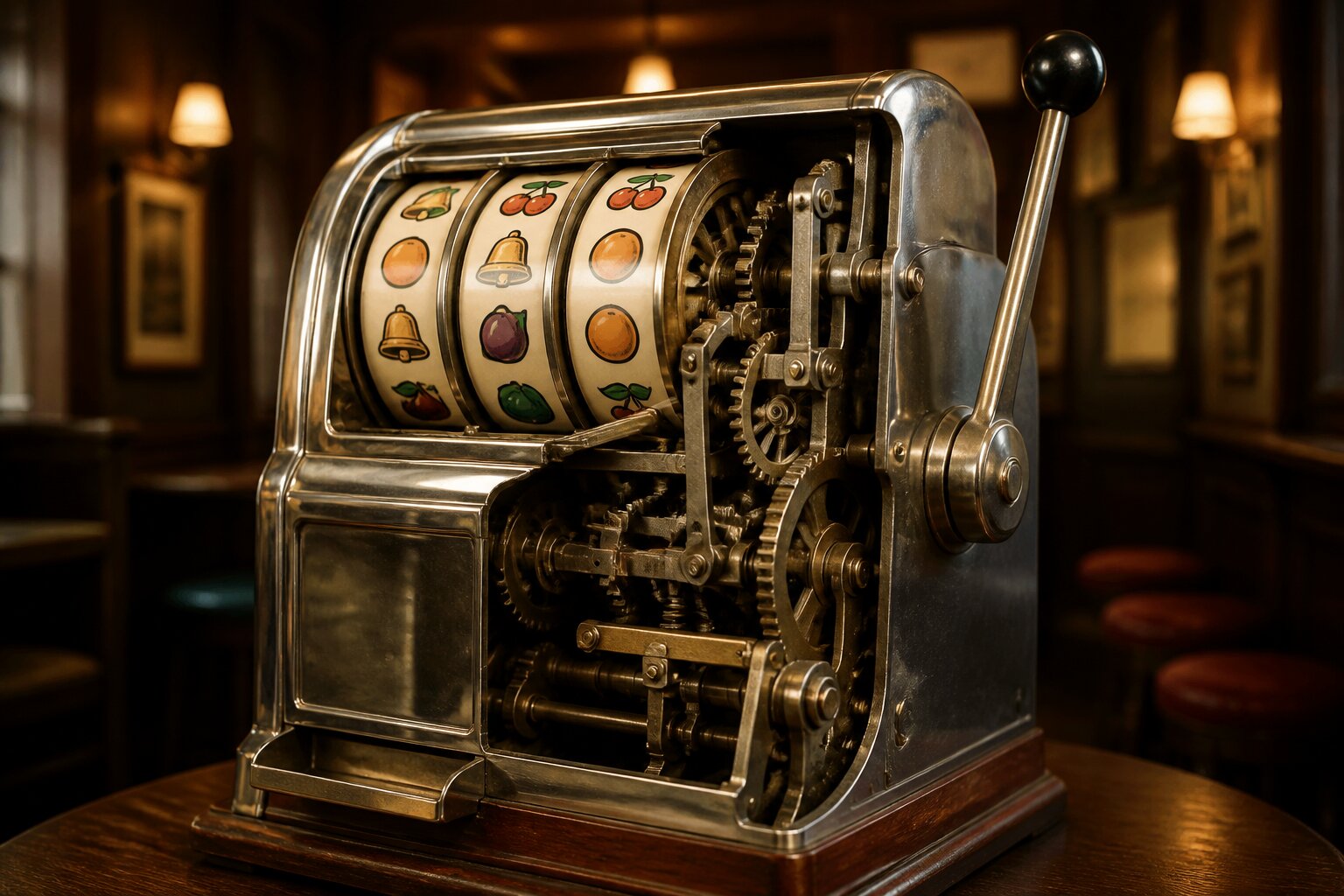
Ever wondered what goes on inside those classic one-armed bandits? The spin of the reels, the clatter of coins and the striking of symbols all hide an elegant mix of engineering and invention.
These machines travelled from smoky saloons to casino floors, becoming icons along the way. If you want to know how levers, gears and springs created a fully mechanical game long before screens and software, keep reading — the mechanics are surprisingly neat and logical.
Curious about how they differ from today’s digital games? This guide walks through their origins, the parts that make them work and the ideas people often misunderstand about them.
What Is a Mechanical Slot Machine?
A mechanical slot machine is a gambling device operated by a physical action, typically pulling a lever or pressing a button that releases stored mechanical energy. Inside, spinning reels are moved by springs, gears and escapements — not by software or electronic systems.
Each reel carries a set of printed symbols. When the reels stop, the alignment of symbols across a payline determines whether a payout occurs. Early designs relied on fully mechanical payout mechanisms: coin trays and payout chutes that delivered coins directly to the player.
Play on these machines feels tactile and audible: the sound of metal moving, the click of stoppers and the clatter of coins on a win. That sensory quality is part of what makes mechanical slots distinct from their electronic descendants.
How Did Mechanical Slot Machines Originate?
Mechanical slot machines emerged in the late 19th century as simple entertainment in bars and saloons. A key early example is the Liberty Bell, developed in 1895 with three spinning reels and an automatic payout mechanism for matching symbols.
Before fully automatic machines, earlier devices used cards or other indicators and required operators to hand out winnings. The Liberty Bell’s combination of a convenient lever, automatic coin payout and easily recognisable symbols made it far more practical for public use.
This move toward automation and straightforward play helped bring the machines into more venues, where their straightforward operation and visible mechanics attracted repeated play.
The Main Components of a Mechanical Slot Machine
Mechanical slot machines depend on a set of robust parts working in concert. Each component has a clear function: to store and release energy, to spin and stop reels, and to register and pay out wins. Understanding these parts shows how purely physical systems created reliable, repeatable game behaviour.
Below are two central aspects that drive their operation.
The Role of Reels and Symbols
Reels are the prominent, rotating cylinders with symbols printed around their edges. When set in motion, they rotate independently and come to rest in sequence. The arrangement and number of symbols on each reel determine the frequency of particular symbol combinations, so designers could shape payout probabilities by changing symbol distribution and reel geometry.
Symbols were chosen for clarity and recognisability; early machines used items like bells, horseshoes and fruit. The payline — usually a central horizontal line — is the reference point for determining matches. When matching symbols align along the payline, the internal mechanism engages the payout apparatus.
Springs, Gears, and Levers: The Engineering Inside
The mechanical heart of these machines is an energy-storage system, most commonly a wound spring. Pulling the handle stores energy in that spring; releasing it drives the reels through a series of gears and an escapement mechanism that controls spin duration and stopping order.
Gears translate the spring’s energy into rotational motion while limiting speed. Escapements and detents act as precise brakes, allowing each reel to stop at discrete positions corresponding to printed symbols. Stoppers and pawls lock reels into place when a valid stopping position is reached, and switches or cams translate symbol alignment into a payout action.
This interplay — energy storage, controlled rotation and mechanical sensing — produces the outcomes players see on the face of the machine. The engineering ensures that each spin ends in a stable, well-defined state that the payout mechanism can act upon.
How Is a Win Determined on a Mechanical Slot Machine?
A win occurs when the reels stop with specific symbols aligned along the payline and the machine’s internal sensing devices register that combination. Mechanical sensors such as notched wheels, switches or levers detect the reel positions and trigger the payout mechanism if those positions match a winning pattern.
Symbol placement across the reels directly affects how often certain outcomes occur. By altering the number of symbol repeats across a reel or the spacing between symbols, designers controlled the statistical frequency of potential wins. The payout mechanism itself — often a spring-driven coin release — is activated by cams or linkages that respond to the registered match.
Because everything is physical, the outcome of a spin depends on how the moving parts interact in that moment: the amount of stored energy released, the friction in gears, and which stopping positions are engaged. These are mechanical processes governed by design and the machine’s condition, and they produce the observable randomness of results without any outside influence.
Are Mechanical and Modern Slot Machines Different?
Mechanical and modern slot machines produce similar types of results, but the technologies behind them differ. Classic machines relied on springs, gears and physical reels; modern machines use digital systems and random number generation to determine outcomes and then display results on electronic reels or animations.
Digital systems achieve unpredictability through algorithms and electronic hardware, while mechanical systems produce unpredictability through physical interactions. In both cases, outcomes are determined by the device’s internal mechanisms and the way they are designed to operate, not by player behaviour or timing.
Regulation and testing apply to both formats to ensure results match the stated return profiles. The user experience differs: mechanical machines emphasise tactile feedback and audible cues, while modern machines often focus on visuals, varying bet structures and a wider range of prize formats.
Common Myths About How Mechanical Slot Machines Work
Many misconceptions have grown up around mechanical slots. One frequent idea is that a machine can be “due” to pay out because of earlier spins; another is that handling the lever in a particular way or striking the cabinet will affect outcomes. In truth, mechanical outcomes are determined by the machine’s internal mechanics at the moment of play, not by prior events or external gestures.
Beliefs about spotting “hot” machines or timing a spin are based on patterns people see in random sequences, but such patterns don’t imply causation. Modern machines, while different in construction, are subject to the same misunderstanding: observable streaks don’t indicate predictable behaviour.
Regulatory checks and independent testing are used to confirm that both mechanical and electronic machines conform to their designed payout frequencies, so players can expect the machines to operate as advertised.
If you’re curious about a machine’s design, looking at reel symbol distribution and payout tables provides clear, factual insight into how frequently certain wins can occur, without relying on folklore or anecdote.
Why Do Mechanical Slot Machines Hold Enduring Appeal?
Mechanical slot machines remain appealing because they offer a tangible, mechanical experience that is easy to understand at a glance. The visible movement of reels, the click of gears and the physical payout of coins create a direct connection between design and outcome that many find satisfying.
They also carry historical and aesthetic value: vintage cabinets and visible mechanisms remind people of the machines’ engineering heritage. While the outcomes are governed by the same carefully designed randomness as modern machines, the sensory detail of mechanical play is unique.
These machines also make the principles of probability and mechanical design accessible; a glance at a reel’s symbol layout can reveal how a manufacturer set the game’s balance between frequent small wins and rarer large payouts.
For anyone interested in the craft of game design, mechanical slots are an elegant example of how engineering and entertainment intersect.
Keep in mind that machines are games built to entertain; their design and regulation ensure predictable behaviour over many plays, and they are best approached with clear limits and a focus on enjoyment rather than expectation.
**The information provided in this blog is intended for educational purposes and should not be construed as betting advice or a guarantee of success. Always gamble responsibly.