
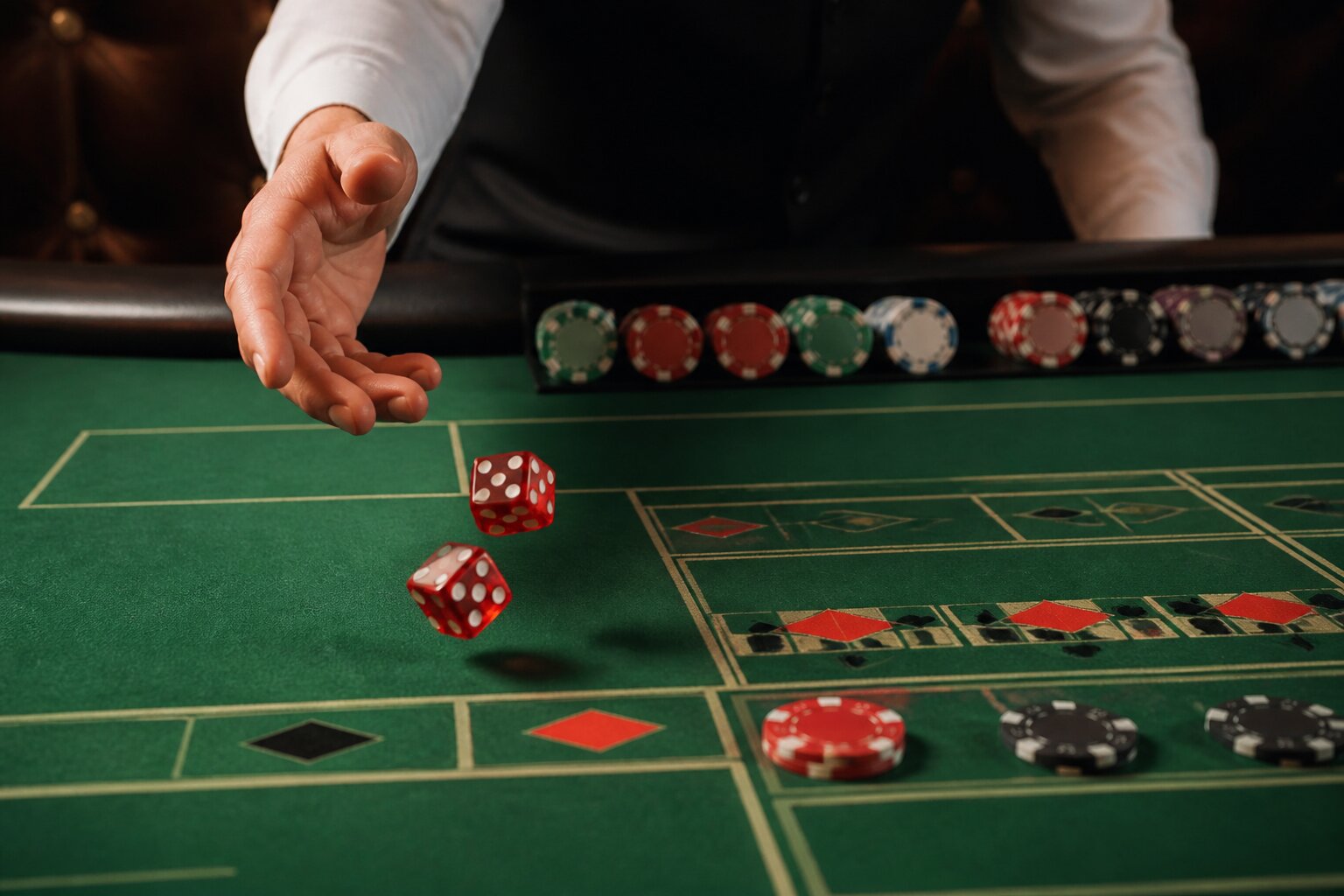
Feeling unsure about the craps table? It can look complicated at first, but once you understand the main bets and how a round flows, it becomes much easier to follow. This guide explains the essentials in plain English, with clear examples and practical tips to help you get started.
We will cover how the game works, the key bets and payouts, common myths to ignore, and basic table etiquette. Read on for a straightforward walkthrough that keeps things simple while giving you the detail you need to play confidently.
What Is Craps & How Does the Game Work?
Craps is a dice game played around a specialised table. Each round centres on the shooter, the person who rolls a pair of dice. Before the dice are rolled, players place bets on where the total will land or on how the round will resolve.
The initial roll is called the come out roll. If the shooter rolls 7 or 11 on that roll, certain bets win outright. If the total is 2, 3, or 12, some bets lose immediately. Any other number becomes the point. The shooter then keeps rolling until they repeat the point, which wins those supporting bets, or roll a 7, which causes those bets to lose.
Every roll is independent and governed by the probabilities of two dice. No strategy can alter the mathematical odds of the outcomes, so betting choices should reflect that reality and your own limits.
Understanding the Craps Table Layout
The table is divided into zones that correspond to different bet types. Along the outside edges is the Pass Line area and its mirror, the Don’t Pass zone. Above these are the Come and Don’t Come areas, which behave like the Pass and Don’t Pass bets but can be placed after the come out roll.
Along the sides are Place Bets, where you back specific numbers such as 4, 5, 6, 8, 9, or 10 to be rolled before a 7. The centre of the table typically contains Proposition bets, which are single-roll wagers with higher payouts and higher house margins. Field bets cover the next roll only and occupy a clearly marked section.
If you are at a live table, you place chips directly onto the area that matches your wager. Online versions let you click or tap the relevant region. Spend a few moments observing the layout before betting so you know where to position your chips and what each area represents.
What Are the Main Bets in Craps?
Below are the bets you will encounter most often, with a concise explanation of how each behaves at the table and what to expect from the odds.
Pass Line Bet
A bet placed before the come out roll that wins on 7 or 11 and loses on 2, 3, or 12. If a point is established, the bet wins if the point is rolled again before a 7. This bet has a relatively low house edge compared to many other options, which makes it a common choice for players who want straightforward action with reasonable odds.
It is simple to follow at the table, and you can usually add odds behind the Pass Line after a point is set to reduce the overall house edge further. That extra bet pays true odds and is treated separately from the main Pass Line stake.
Don’t Pass Bet
Placed before the come out roll, this bet wins on 2 or 3 and usually loses on 7 or 11. A 12 often results in a push depending on house rules. After a point is set, the bet wins if a 7 appears before the point is repeated.
The Don’t Pass is sometimes called the wager for players who prefer to play against the table rather than with it. Under standard rules the house edge on Don’t Pass is slightly lower than on the Pass Line, but it can feel less social since it wins when the table loses.
Come Bet
Placed after the come out roll, this bet behaves like a Pass Line wager but starts on a later roll. It moves into its own “point” area after the first roll and then functions the same way as a Pass Line bet with respect to that point.
Come bets are useful if you missed the initial come out roll but still want to get in on Pass Line style action. Like the Pass Line, you can usually take odds on a Come bet once its point is established.
Don’t Come Bet
The counterpart to the Come bet, placed after the come out roll. It operates like the Don’t Pass bet but begins later in the round.
Don’t Come bets let you take a similar position to the Don’t Pass but only after play is already underway. They carry the same basic math as Don’t Pass wagers and can also have odds taken against them in some casinos.
Place Bets
These let you back specific numbers to be rolled before a 7. Payouts and house edges vary by number. Betting on 6 or 8 is generally more favourable than betting on 4 or 10 because the payout structure better reflects the true odds.
Place bets are flexible because you can choose which number or numbers to back and you can usually remove or add them between rolls. The trade off is that payouts are fixed and the house edge differs noticeably from number to number.
Field Bet
A single-roll wager covering a selection of numbers on the next roll. Some casinos pay higher on certain numbers within the field, so check the paytable before placing this bet.
Field bets resolve quickly since they apply to one roll only. They are often tempting for casual players because of occasional higher payoffs, but the house edge varies depending on the specific pay structure at the table.
Proposition Bets
Found in the centre of the table, these bets cover exact totals or specific combinations on the next roll. They offer larger payouts but carry significantly higher house margins and volatility.
Typical proposition bet types include:
- Specific totals such as 2, 3, 11 or 12
- Hardways where a pair makes a total, for example two threes for a hard six
- Specific combinations like two sixes or snake eyes
Because of the high house edge, these bets are best treated as occasional side wagers rather than core strategy.
Choosing which bets to make depends on how you want to balance risk and potential return. Consider factors such as:
- Your bankroll and how much you can afford to lose
- Your tolerance for volatility and how quickly you want results
- Your level of experience and comfort with the table layout
For beginners, simpler bets with smaller house edges are often the most sensible starting point. Remember to treat play as entertainment, set limits, and gamble responsibly.
How Do Payouts Work in Craps?
Payouts match the mathematical probability of a given outcome as set by the table. Even-money bets return a one-to-one payout on wins. For example, an even-money bet of £10 that wins returns your £10 stake plus £10 in winnings.
Place Bets pay according to the number chosen. Numbers that are rolled more frequently pay less relative to the stake, while rarer numbers pay more. For instance, 6 and 8 often pay 7 to 6, while 4 and 10 typically pay 9 to 5. Field bets usually pay even money but may offer double for specific numbers on some tables.
Proposition bets can show payouts such as 7 to 1 or higher, reflecting their lower chances of success. Always consult the paytable at the table or on the game screen so you know the exact return before you commit chips.
Which Craps Bets Are Best for Beginners?
Beginners will find the Pass Line and Don’t Pass bets straightforward because they require little bookkeeping and give a clear sense of how a round unfolds. Come and Don’t Come bets are natural extensions once you are comfortable with the basic flow.
Place bets on 6 and 8 can also be a sensible choice for those who want to combine a slightly better payout profile with modest complexity. More exotic options such as Proposition bets are best left until you understand probability and payout relationships well.
Deciding where to place your money is a personal choice informed by how much variance you are comfortable with and how long you want your bankroll to last.
Are There Any Craps Betting Myths to Avoid?
Several persistent beliefs about craps can lead to poor choices. One is the idea that previous rolls influence future ones. Each roll is an independent event determined by dice probabilities, so past results do not improve or worsen the chance of particular totals appearing in subsequent rolls.
Another misconception is that certain throwing techniques can reliably influence outcomes. Casinos enforce rules to ensure rolls are fair, and in regulated online games the result comes from certified random number generation. Likewise, betting systems that promise guaranteed wins do not change the underlying odds.
Sticking to clear, evidence-based thinking about probabilities will help you make better betting decisions and avoid patterns that can increase losses over time.
Essential Craps Etiquette for New Players
Table manners matter, especially in the social setting of a craps table. When arriving at a live game, wait until the current round is over before placing your bet. Place chips neatly so the dealer can clearly see your wager. If you are unsure where to put a bet, a quick question to the dealer is perfectly acceptable.
As the shooter, pick up the dice with one hand and roll them in a controlled manner down the table. Avoid excessive force or wild throws that could disrupt play. If you are online, keep chat messages courteous and concise so other players are not distracted.
Alongside polite behaviour, manage your play by setting personal limits and taking breaks if you need them. That keeps the experience enjoyable for you and everyone at the table.
Glossary of Common Craps Terms
Here are common terms you will see at the table, explained clearly to help you follow play.
Shooter
The player who rolls the dice during a round.
Pass Line
A bet made before the come out roll that wins on 7 or 11 and loses on 2, 3, or 12. If a point is set, the bet wins if the point is rolled again before a 7.
Don’t Pass
A bet made before the come out roll backing the 7 or 11 to lose on the come out roll and certain low numbers to win. After a point is set, it wins if a 7 appears before the point.
Point
A number established on the come out roll that the shooter must repeat to win certain bets.
Come Bet
A later bet that functions like a Pass Line wager starting on the roll after it is placed.
Don’t Come
A later bet that functions like a Don’t Pass wager starting on the roll after it is placed.
Field Bet
A one-roll bet on a small group of numbers on the next roll.
House Edge
The built-in advantage the casino has over players for each type of bet.
Proposition Bets
Single-roll wagers on specific totals or combinations typically placed in the centre of the table.
These terms will help you read the table and understand what other players and dealers are saying.
Play thoughtfully, be aware of the odds behind each option, and enjoy learning the game. With familiar terms and a basic grasp of the main bets, you will find craps easier to follow and more enjoyable to watch and play.
**The information provided in this blog is intended for educational purposes and should not be construed as betting advice or a guarantee of success. Always gamble responsibly.