
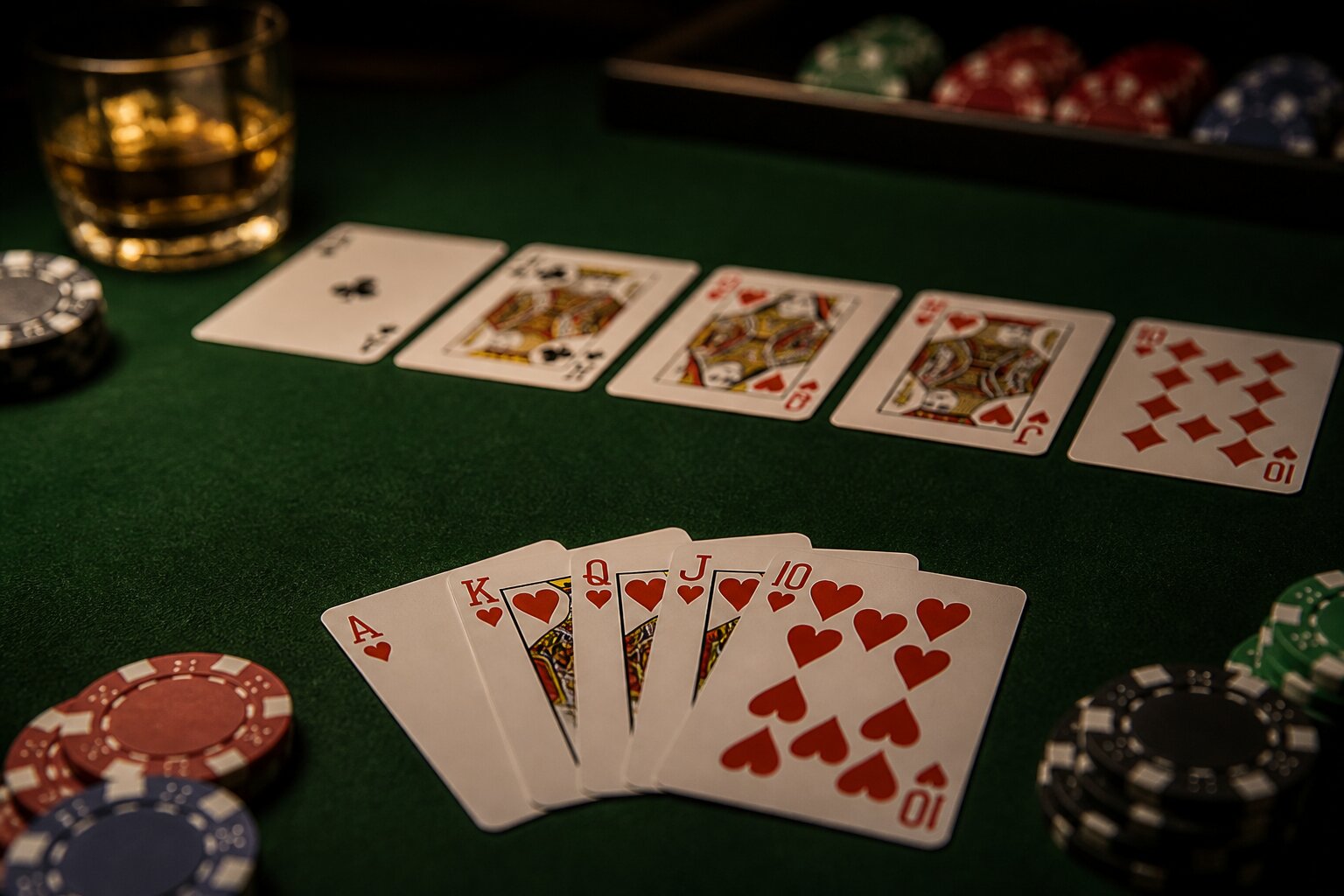
Picture the tension at your local card table: the final card is dealt and the chips clatter as players reveal their hands. Who’s holding the ace up their sleeve, and who’s bluffing with a high card? Knowing exactly which poker hand tops the lot — and when your straight might beat someone else’s three-of-a-kind — can mean the difference between scooping the pot and walking away empty-handed.
Whether you’re a regular in home games or sharpening up before a bigger night out, mixing up the hand rankings can cost you. The order of poker hands isn’t always obvious, and a clear grasp of it helps you make better decisions from the first deal through to the showdown.
Mastering these basics isn’t only about memorising lists; it changes how you read a hand, size your bets and plan your play. Read on to learn the full ranking order, the subtle differences between similar hands, and how top combinations influence play.
Understanding Poker Hand Rankings
Poker hand rankings are the fixed order used to decide which five-card hands beat others. This hierarchy is the backbone of hold’em, Omaha and most other poker variants: when multiple players reach a showdown, the ranking determines who takes the pot.
At the very top sits the Royal Flush — ace, king, queen, jack and ten in the same suit. Just beneath it is the Straight Flush, five consecutive cards all in the same suit. Four of a Kind follows, where four cards share the same rank plus any fifth card. Further down are the Full House (three of a kind plus a pair), Flush (five cards of the same suit), Straight (five consecutive ranks in any suits), Three of a Kind, Two Pair, One Pair and, finally, High Card.
These rankings are used every hand and underpin tactical choices throughout play. Probability and game dynamics will influence outcomes, so a good sense of rank and relative rarity will help you weigh the strength of your holding and how opponents might respond. Next we’ll look specifically at the very strongest hand and what makes it so rare.
What Is the Strongest Poker Hand?
The strongest possible hand in poker is the Royal Flush: ace, king, queen, jack and ten all in the same suit (for example A♣ K♣ Q♣ J♣ 10♣). It is the only five-card combination that cannot be beaten by any other hand.
Statistically, a Royal Flush is exceptionally uncommon. In Texas Hold’em, for instance, the probability of being dealt a Royal Flush by the river is tiny, which is why it is prized when it does occur. Even so, the rarity of a Royal Flush doesn’t replace sound play; a dominant hand still needs to be played in a way that extracts value without exposing it to unnecessary risk.
With that peak in mind, the next section lays out the full, precise order of hands so you can compare holdings at a glance.
How Are Poker Hands Ordered?
Poker hands are ranked from strongest to weakest, and knowing this order is essential during a showdown and for judging relative hand strength in play. The official ranking from top to bottom is:
Royal Flush: A♦ K♦ Q♦ J♦ 10♦
Straight Flush: 9♣ 8♣ 7♣ 6♣ 5♣
Four of a Kind: Q♠ Q♦ Q♥ Q♣ 4♠
Full House: 8♠ 8♦ 8♣ 3♠ 3♥
Flush: K♣ J♣ 8♣ 5♣ 2♣
Straight: 5♠ 4♦ 3♣ 2♥ A♦
Three of a Kind: 7♣ 7♥ 7♠ Q♦ 6♣
Two Pair: 10♠ 10♣ 5♦ 5♠ 3♥
One Pair: J♥ J♣ 8♦ 4♠ 2♠
High Card: A♠ 10♦ 9♣ 5♣ 2♦
Every showdown outcome is resolved by comparing hands according to this list. Where two players hold the same category — two flushes, for example — the winner is determined by the highest card(s) within that category. The next section explores those close comparisons that often decide pots.
Key Differences Between Similar Poker Hands
Some hands look similar at first glance but rank quite differently; spotting the distinction early can prevent costly errors. The key differences often hinge on suit uniformity versus sequential order, or on how many matching ranks you hold.
How Do a Straight and a Flush Differ?
A Straight is five cards in numerical sequence regardless of suit (for example 4♠ 5♣ 6♦ 7♥ 8♠). A Flush requires five cards of the same suit, not in sequence (for example A♣ 9♣ 7♣ 4♣ 2♣). Because it is harder to assemble five cards of the same suit than five consecutive ranks, a Flush ranks above a Straight.
Understanding this distinction clarifies why a hand that looks strong in isolation may actually be relatively weak against certain opponents' holdings. The next comparison highlights another frequent point of confusion at the table.
Is a Full House Better Than Four of a Kind?
A Full House contains three cards of one rank and two of another (for example 9♣ 9♠ 9♦ 5♣ 5♠). Four of a Kind is four cards of the same rank plus any fifth card (for example 7♥ 7♦ 7♣ 7♠ Q♦). Four of a Kind ranks higher than a Full House because holding all four cards of a rank is statistically less common and therefore stronger in head-to-head comparisons.
These fine distinctions influence bet sizing and whether a player chooses to continue or fold. With those contrasts clear, the next section examines the most modest category — high card hands — and when they can still claim a pot.
High Card Hands: What Counts?
A high card hand occurs when none of the recognised combinations are present: no pairs, no sequences, and not all the same suit. The hand is then named for its highest card — for example, 10♣ 8♦ 6♠ 4♠ 2♥ is “ten-high”.
When two players both hold only high cards, the highest single card decides the winner; if those are identical the comparison moves to the next-highest card, and so on. High card outcomes are common in large-field games or when community cards fail to pair up players’ holdings. Winning with a high card often depends on positional play and the way betting lines unfold, rather than the hand’s intrinsic strength.
Now that high-card situations are clear, the following section explains why knowing the rankings matters beyond just the showdown.
Why Are Poker Hand Rankings Important?
Hand rankings settle the result of every showdown and shape decision-making throughout a hand. They tell you whether a particular holding is strong enough to call, raise or fold relative to what opponents might have.
Beyond showdown resolution, rankings also inform strategy: knowing how likely particular hands are to appear helps judge whether a bet should be sized to protect a made hand or to extract value. They also underpin reading opponents; for example, a visible straight on the board alters the probability another player holds a stronger hand such as a flush or full house.
Clear knowledge of the order prevents misunderstandings at the table and builds confidence when pushing for the pot. With that as context, the final section summarises the classic top combinations you should recognise instinctively when they appear.
Top Card Combinations Explained
Top card combinations are the highest-ranking five-card hands and the ones most likely to win at showdown. Below are the canonical examples and a brief note on what each one implies in play.
Royal Flush: A♠ K♠ Q♠ J♠ 10♠ — the absolute top hand; unbeatable.
Straight Flush: 8♥ 7♥ 6♥ 5♥ 4♥ — five consecutive cards of the same suit; extremely strong.
Four of a Kind: J♣ J♠ J♦ J♥ 9♦ — very powerful and often wins large pots.
Full House: Q♥ Q♣ Q♦ 3♠ 3♣ — a combination that can beat many single-pair and flush holdings.
Flush: A♦ J♦ 9♦ 5♦ 2♦ — suit uniformity gives this hand strength against straights and lower-ranked hands.
Straight: K♠ Q♦ J♣ 10♠ 9♥ — sequence-based hands that are vulnerable to flushes.
Three of a Kind: 5♣ 5♦ 5♥ K♦ 8♠ — solid but can be outpaced by straights or full houses.
Two Pair: 8♠ 8♣ 6♦ 6♠ 4♥ — a common winning hand but susceptible to higher pairs or trips.
One Pair: 4♦ 4♠ A♠ 10♥ 7♣ — the most frequent made hand in many games.
High Card: K♥ 10♣ 7♦ 6♣ 3♠ — lowest category, occasionally enough to win when no one else connects.
Recognising these combinations quickly helps with reading boards and estimating opponents’ ranges. Keep these ranks in mind at the table so you can act decisively when value is on offer.
Explore Casino Games at Online Slots UK
We invite you to enjoy the wide range of casino games waiting for you on our site. Join us for an entertaining experience, all in one convenient place.
It is straightforward to begin: just create your account, make a deposit and you will be ready to explore. We look forward to welcoming you to our community.
**The information provided in this blog is intended for educational purposes and should not be construed as betting advice or a guarantee of success. Always gamble responsibly.