
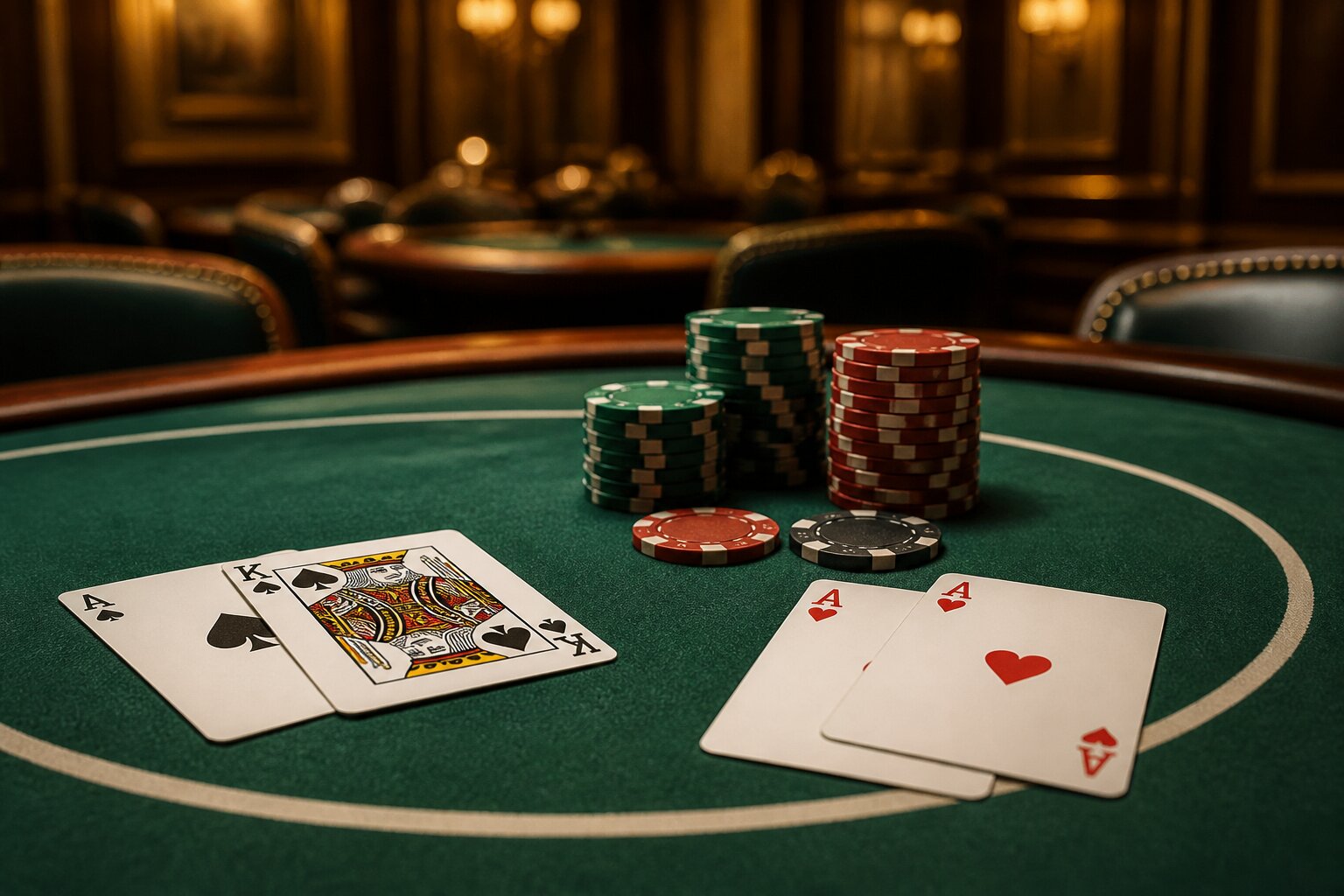
Ever found yourself at a casino table, cards in hand, wondering what really sets blackjack apart from poker? It’s a common mix-up—after all, both games use the same deck, and both can be played for serious sums of money. But while they look similar at first glance, beneath the surface they offer very different experiences.
Maybe you’ve seen someone coolly slide chips across the table and wondered whether that was blackjack or poker, or you’ve heard talk of ‘hitting 21’ versus ‘a royal flush’ and wanted to know what the difference actually is. The distinctions matter: rules, strategy and the social feel of each game shape how you play and what you enjoy.
This article breaks down those differences clearly, so you can spot which game suits you and know what to expect at the table.
What Is the Difference Between Blackjack and Poker?
Blackjack and poker may use the same cards, but that’s about where the similarity ends. In blackjack, you’re playing only against the dealer, aiming to get closer to 21 than they do without going bust. If your hand exceeds 21, you lose the round immediately.
Poker is primarily about competing with the other players at the table. Success depends on making the best five-card hand or using betting to make others fold. The house doesn’t compete in the same way; it takes a fee from the game instead.
Blackjack rounds are typically faster and more uniform: each player places a bet, plays a hand against the dealer, and receives an immediate outcome. Poker involves several betting phases, greater interaction and the chance to influence opponents’ decisions. Deck usage differs too—blackjack often uses multiple decks shuffled together, while most poker variants use a single deck each hand.
With those basics clear, we can look at how each game developed historically and why they evolved so differently.
Origins and Histories of Each Game
Card games have long been woven into British social life, but blackjack and poker arrived via very different routes and traditions. Each carried its own culture and customs as it moved between countries and centuries, shaping how people played and what they expected from a game night. These differing histories also influenced how the games are organised in casinos and clubs today.
Where Did Blackjack Originate?
Blackjack can be traced back to 18th-century France, where a game called Vingt-et-Un (meaning 21) was popular in salons. It was played among the middle and upper classes and often appeared in literary and social accounts of the period, which helped it spread across Europe. As play migrated to other countries, local rule changes and customs altered the structure and betting mechanics.
When the game reached America it picked up new variations and names. The term ‘blackjack’ itself came from an early bonus payout that involved specific card combinations; the bonus faded over time but the name remained in common use. Gradually, through both private games and the formalising influence of organised gambling venues, the rules were standardised into the version widely played in casinos today. The modern game retains the clear dealer-versus-player format that made it easy to adopt in regulated gaming environments.
How Did Poker Develop?
Poker’s origins are more diverse, drawing influence from older card games across Europe and Persia. Variants from different cultures contributed elements such as betting rounds, bluffing and hand rankings. The game gained a distinct identity in 19th-century America, where riverboat games on the Mississippi and frontier gambling houses helped create its competitive, player-versus-player nature.
During that era poker evolved rapidly, and players experimented with different formats and stakes. This experimentation led to many regional variants and eventually to the establishment of community-card games like Texas Hold’em and Omaha. These forms later became staples in card rooms around the world, prized for their blend of probability, psychology and strategic depth. Unlike blackjack, poker emphasises player interaction, reading opponents and adapting strategy over many hands.
Those historical paths explain why blackjack kept a relatively simple, dealer-focused structure while poker evolved into a multifaceted contest between players. The two traditions reflect different social settings and priorities, which is also why they attract different kinds of players today. Next we’ll compare how the rules and typical gameplay differ in practice.
How Are the Rules and Gameplays Different?
On the surface both games require basic card knowledge, but their structures, pacing and objectives diverge significantly.
Objective of Blackjack vs Poker
Blackjack’s objective is direct: beat the dealer by having a total closer to 21 without going over. Each player’s result is resolved against the dealer’s hand alone, so the table’s other players do not affect your outcome.
Poker’s objective depends on the variant, but generally it centres on constructing the best possible five-card hand or using betting to force opponents out. Success hinges on reading opponents, managing bets and adapting to the changing board as community cards are revealed.
Key Rules That Set Them Apart
Blackjack starts with two cards dealt to each player and the dealer. Players choose from a limited set of options—hit, stand, double down or split—and the dealer follows a fixed rule set when drawing. Betting is placed once per round and outcomes are immediate.
Poker, for example in Texas Hold’em, begins with two private ‘hole’ cards per player and then deals five community cards in stages. Betting rounds occur between those deals, and players can check, call, raise or fold. The winner is the player left in the hand with the best combination at showdown, or the one who successfully makes everyone else fold.
These structural differences influence the tempo and decision-making each game demands: blackjack leans on quick, rule-driven choices, while poker rewards sustained strategy and psychological judgement. With the gameplay distinctions in mind, it helps to understand how cards and deck use shape each experience.
Card Values and Deck Use Explained
Both games use a standard 52-card pack, but how cards are valued and how many decks are used change the way each game feels.
In blackjack, cards have simple values: numbered cards equal their face value, face cards count as 10, and aces can count as 1 or 11 depending on which suits the hand best. Casinos often use multiple decks to make long-term prediction techniques less effective; you’ll commonly see four to eight decks dealt together in table play.
Poker relies on one deck per hand and judges hands by set rankings rather than single numeric totals. The suit matters only in determining flushes and tie-breakers, while the combination of ranks establishes the hand’s strength. Typical hand rankings from highest to lowest are:
- Royal Flush: Ace, King, Queen, Jack, 10 of the same suit
- Straight Flush: Five consecutive cards of the same suit
- Four of a Kind: Four cards of the same rank
- Full House: Three of a kind plus a pair
- Flush: Five cards of the same suit
- Straight: Five consecutive cards of mixed suits
- Three of a Kind: Three cards of the same rank
- Two Pair: Two different pairs
- One Pair: Two cards of the same rank
- High Card: No other combination; the highest card wins
The contrasting card uses—multiple decks and numeric targets in blackjack versus a single deck and combinational ranks in poker—help explain why each game develops different strategies. Knowing that, we can consider how chance and skill balance out in practice.
Is the Role of Skill and Chance the Same?
Both games mix skill and chance, but they do so in different proportions and in different ways.
Blackjack revolves around fixed probabilities tied to the remaining cards and a narrow set of choices. Decisions like whether to hit or stand affect immediate outcomes, and hand rankings can reduce the house edge, but the house retains a mathematical advantage over time.
Poker places greater emphasis on skill relative to chance. While the deal of the cards is random, successful long-term play depends on reading opponents, managing stakes and making strategically timed bets. Skilled players can achieve a performance edge over less experienced opponents across many hands, though any single hand still depends on the cards that appear.
It’s important to view card games as paid entertainment rather than a route to earnings. Keep stakes proportionate to what you can afford, and approach play as a recreational activity with variable outcomes. With that perspective, the different table atmospheres become clearer.
Table Dynamics: How Players Compete
The competitive environment at each table reflects their differing objectives.
Blackjack tables tend to be individual contests against the dealer. Players focus on their hands and the dealer’s visible card; the atmosphere is often calm, with players concentrating on choices that affect only their outcomes. Conversation is typically light and incidental.
Poker tables are interactive and tactical. Each decision can influence the pot and the behaviour of other players. Observation, timing and table talk all feed into the game’s psychology. Dealers facilitate, but the real contest takes place between the people around the table, with shifting alliances and rivalries emerging as hands progress.
These contrasts help explain why venues set up distinct spaces for each game and why players often choose one over the other. If you’re wondering which attracts larger crowds or which you’re more likely to find on the casino floor, the next section answers that.
Which Game Is More Popular in UK Casinos?
Blackjack is widely accessible and commonly offered across casino floors and online platforms, making it one of the most frequently played table games in the UK. Its simple rules and brisk rounds suit casual players and those who prefer a quick outcome.
Poker also enjoys strong followings, particularly in dedicated poker rooms and during organised events and tournaments. While day-to-day poker tables may be fewer than blackjack tables, scheduled tournaments and cash games attract committed players and can create lively scenes when popular events run.
Overall, blackjack tends to be the more consistently present choice for walk-up play, while poker draws crowds for its social challenge and competitive depth. Both games remain staples of the casino experience and cater to different preferences among players.
The key takeaway is that whether you prefer a fast, dealer-focused contest or a longer, player-versus-player strategic battle, there is a clear option for you at the casino and online.
Explore Casino Games at Online Slots UK
We'd love for you to discover the great variety of casino games waiting for you on our site. With so many options, there's always something new to enjoy and explore.
Getting started is nice and easy: just create an account, make a deposit and you're ready to play. Join us whenever you fancy and see what takes your interest.
**The information provided in this blog is intended for educational purposes and should not be construed as betting advice or a guarantee of success. Always gamble responsibly.